


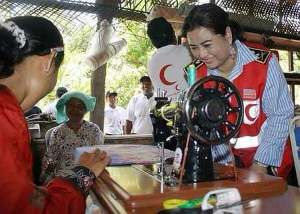
She went, she saw, and she came away from Kampung Peta impressed by the way the villagers there lived simple but meaningful lives in tune with nature.
THE journey to Kampung Peta in the Endau-Rompin National Park was actually worth every backbreaking bit of it. As we drove deep into the jungle, the beauty of the lush, green ferns and tall trees around us was truly breathtaking.
Not so picturesque were the small mounds of elephant droppings, but I’m happy to say that no irate elephant emerged to attack our convoy of cars.
I went. I saw. I was overcome by a myriad of emotions, not least a great sense of confusion. I had expected to see only dilapidated wooden houses but as we came within sight of the kampung, I saw looming in the distance a three-storey school.
A few minutes later, we were informed that it had 10 teachers and about 35 students.
If I hadn’t reined in my more than active imagination, I would have thought that the school building had floated along with the floodwaters of last year and found its way to Kampung Peta.
Later, at home, when my husband asked me about the kampung, I could only stammer, “There’s a three-storey school building there.”
He nodded, “I know.”
He knew because he had performed the school’s opening ceremony a few years back.
Apart from my amazement at seeing that concrete behemoth, my memories of my first visit to Kampung Peta include being afraid of falling on my face as I walked along the lanes of the little village with government officials and Red Crescent volunteers. To prevent this, I had borrowed Son No. 4’s shoes, and thankfully, I didn’t slip even when walking on uneven paths and slippery, muddy patches of grass.
We toured three different parts of the kampung, including the site for a library. It was to be a decent-sized building, as we saw from the plan displayed on a wooden board.
Remembering the sincerity of those who had made large donations to develop this kampung, I felt we had to be accountable and responsible for what was given to us and not build more than what was needed.
As we stood on a slope looking down at the river flowing placidly by, the Tok Batin (headman) showed us where the jetty used to be. During the floods, the water level had risen so high that the slope we stood on as well as the houses nearby had been inundated.
An old sampan carved out from the trunk of a tree lay near where I stood. We – the apparently more sophisticated city folks – suggested to the Tok Batin that the sampan be kept. What boat-builders make with the help of machines, the orang asli had carved with their own hands. That sampan reinforced my belief that they have far superior knowledge about living with nature than we do.
The next interesting spot was a small wooden stall where puzzles made from rattan were sold to visitors at the Endau-Rompin park. The owner, Awang, showed me how a string inside the puzzle could be “released” in six, eight or 12 steps. He also presented me with a set of three puzzles.
Someone suggested that he provide diagrams showing each step to getting the string out of the rattan maze but he wisely refused. The puzzles are now on top of my dressing table, taunting me: “How to make yourself look like an idiot in six, eight or 12 easy steps.”
The next time I visit Kampung Peta, I’m taking a videocamera with me and I am going to record Awang’s deft fingers removing the string from the coils of rattan. We can then patent the puzzles and Awang can retire with a modest income.
Having now had the experience of being in a wooden rather than a concrete jungle, I feel more confident about staying away from the bright city lights and spending leisurely hours chatting with the women at Kampung Peta as they sew pieces of batik together on the new sewing machines we had given them.
They are a jolly lot – all smiles, guffaws of laughter and warmth that comes from the heart. They greeted us at the entrance of the “sewing centre” with songs and dances. An old man whose violin was broken became the proud owner of a new one, and he was part of the enthusiastic band who played catchy tunes while three women sang.
After they finished singing, I asked an elderly woman how old she was, and her reply was that she didn’t know because her parents had not recorded her year of birth. What a wonderful excuse for women to use: we can then decide that we are all no older than 35.
I did not have to sleep in a tent after all because there are comfortable cabins in the area for visitors to stay in. Generators provided electricity and there were also satellite dishes around.
It was quite strange that as we marvelled at the beauty of the rapids, the rivers and the cooling canopy of trees above us, our hearts beat less rapidly and our minds became clearer. It was as if the things that cluttered our thoughts had evaporated, borne away by the fast rapids and the sighing breeze. I saw the same awe and amazement I felt reflected in everyone’s face. This is indeed a world worth saving.
I know that the G8 leaders were just in Heiligendamm (Germany) to discuss global warming but I wish we could invite them here, to this little corner of the world, where time goes by at a slower and more peaceful pace. I can imagine Tony Blair dancing with one of the orang asli women, and Angela Merkel being mesmerised by that old man with the violin.
For the moment, that’s all I can do: imagine.
But what’s more important is that the people of Kampung Peta have given us their time and their smiles.
The writer is Royal Fellow, School of Language Studies and Linguistics, UKM, and Chairperson, Community Services Committee of the Malaysian Red Crescent Society.
On Giving
“There are those who give little of themuch which they have – and they give itfor recognition and their hidden desiremakes their gifts unwholesome.
And there are those who have little andgive it all.
These are the believers in life and thebounty of life, and their coffer is neverempty.
There are those who give with joy, andthat joy is their reward.
And there are those who give withpain, and that pain is their baptism.
And there are those who give andknow not pain in giving, nor do they seekjoy, nor give with mindfulness of virtue;
… It is well to give when asked, but it isbetter to give unasked, throughunderstanding.”
– Khalil Gibran
10 June 2007 : The Star, Mind Matters

